

Pass the Parcel
One VLCC, five charter contracts, and huge amounts of money changing hands.

The DHT Puma and its web of commercial contracts is a complex case study on how skyrocketing supertanker rates after U.S. and Israeli attacks on Iran (February 28, 2026) produced unprecedented winners and losers.
To follow the money, we need to untangle the web of commercial contracts that lead back to the 2016-built Very Large Crude Carrier (VLCC) at the center of this story: the DHT Puma.
February 2023: DHT (publicly-listed Norwegian owner of the DHT Puma) chartered the DHT Puma to Mercuria (privately-held Swiss commodity trader) for three to four years.
The charter had some nuance to it, whereby DHT would receive a base-rate of $33,500/day from Mercuria and then be entitled to a variable profit share.
If VLCC earnings exceeded the base rate of $33,500/day, DHT would receive 100% of the profit share up until the $40,000/day level, at which point they would receive a 50% profit split.
December 2023: Mercuria chartered the DHT Puma to Hunter Group (publicly-listed Norwegian investment company) at $52,500/day for three years (a tidy profit of $19k/day above the base rate paid to DHT). Simultaneously, Mercuria agreed to take the vessel back on charter for a matching three-year period on an index-linked basis, meaning payments would be dependent on market assessments for VLCC rates each day (now the profit isn’t so tidy).
December 2025: Mercuria reportedly chartered the ship to Sinokor (privately-held Korean shipping company) for one year at around $55,000/day.
March 2026: Sinokor chartered the vessel to Petrobras (publicly-listed, state-owned Brazilian oil company) to carry crude oil from Brazil to China at $185,000/day for a voyage that would last 91 days.
This timeline is a lot to keep track of and illustrates the frenetic contracting nature of VLCCs in today’s supercharged rate environment.
So, who is making money?
After running some back-of-the-envelope-math for the month of April:
Sinokor made $128k/day,
DHT made $217k/day,
Hunter Group made $388k/day,
And
Mercuria lost $573k/day.
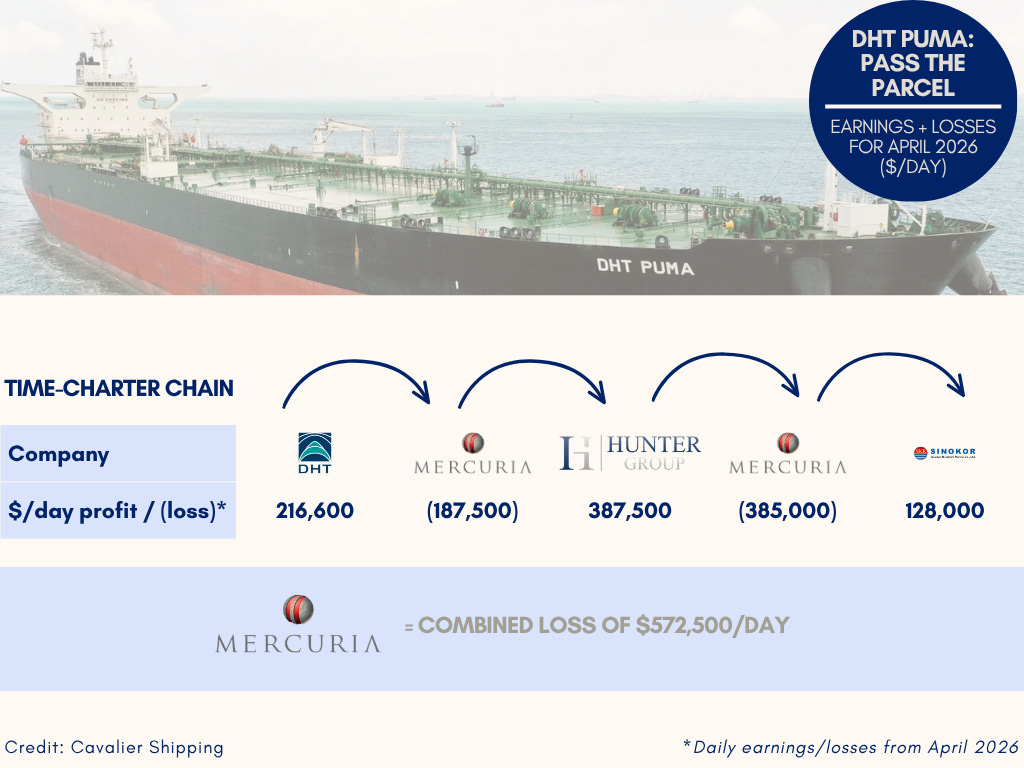
Before anyone starts getting overly concerned about the commodity traders in Switzerland, it is possible that they used derivative contracts — freight forward agreements (FFAs) — to hedge their exposure, so their financial position might not be as bleak as the figure suggests.
In fact, commodity traders like Mercuria are well-known for their heavy use of derivatives to ensure that they come out on the winning side of trades.
How would making money off of derivatives work?
FFAs, including those for VLCCs, are settled against indices produced by the Baltic Exchange.
If Mercuria had indeed hedged its exposure to these index-linked contracts using FFAs, it would be critically important for them to stand behind the Baltic Exchange to ensure their derivative contracts settled as they had intended and continue making payments as agreed.
And what’s the reality for DHT Puma contract holders?
A Reuters headline from May 1, 2026 reads “Trader Mercuria sues Baltic Exchange over Hormuz freight losses, court filing shows.” With Mercuria reporting in court filings that their losses were “presently estimated to be in the hundreds of millions of U.S. dollars.”
Relatedly, Hunter Group disclosed on May 18 that they have not been paid more than $17 million that they are owed from one of their counterparties.
Maybe Mercuria wasn’t hedged after all.
Related Posts


Complete this survey if you’re interested in sponsoring a future Freight + Fortune post.